Sunday, January 22, 2006

Many Happy Returns...


I was traveling Friday and unfortunately missed the chance to note a happy anniversary. Friday was the twenty-fifth anniversary of Ronald Reagan as the fortieth President of the United States of America. You could easily make an argument that the most important President of the twentieth century was Franklin Delano Roosevelt, and you’d probably be right. However, I don’t think there is any argument over who was second, and in the category of favorites (at least for me) first, and that is Ronald Reagan.

There was a great op-ed piece in Friday’s Wall Street Journal entitled “Still Morning in America.”:

“Perhaps the greatest tribute to the success of Reaganomics is that, over the course of the past 276 months, the U.S. economy has been in recession for only 15. That is to say, 94% of the time the U.S. economy has been creating jobs (43 million in all) and wealth ($30 trillion). More wealth has been created in the U.S. in the last quarter-century than in the previous 200 years. The policy lessons of this supply-side prosperity need to be constantly relearned, lest we return to the errors that produced the 1970s.”

I was in the Boston Museum of Science this weekend and happened past an exhibit on the ever changing population of the United States. The current population of the United States is estimated at just over 297 million people. People are being born at rate faster than they our dying in the country, but statistics that most interested me dealt with choice. Every 38 seconds someone in the world immigrates to the United States. The statistic for people emigrating, or moving away from the United States, was one every 137 seconds (it may have been 178 or 187 – should have written it down).

What the statistics above tell me is that when a decision is based on choice – where to live, the United States has a net gain of people voting “with their feet” to live here. It would be interesting to compare these numbers with those of other nations, especially those that are often held up as better at this or that than the United States.

Rightly or wrongly, in my heart of hearts I still believe in the United States as the land of opportunity. Not perfect in any way, but definitely the fairest, the most hopeful, and always representative of any honest, hard-working person’s best chance. I love Ronald Reagan not just for his numerous accomplishments (say…saving the entire world from Nuclear Holocaust- gotta love that one!), but because he never stopped believing in America. Ronald Reagan, more than any other President in the twentieth century, did the most to hold up the U.S. as the “shining city on a hill,” and to re-introduce Americans to the goodness that is the United States of America.

Monday, January 16, 2006

A great listen...


Years ago, if you volunteered that you liked “books on tape,” you were liable to provoke a few snickers (maybe that’s just because I hung out with English majors). To fit on the most common format, two cassettes (about three hours of listening) most books required drastic cutting to fit onto this new audio format. Listening to something on tape back then was equated with reading the “Cliff Notes,” instead of doing the work to read something.

However, in college in 1989 and finding myself driving my mother’s Ford Escort with an AM radio only (same Car/AM radio combination that introduced me to Rush by the way) I was lucky enough to stumble upon my first book on tape. I was even luckier when it turned out to be a great story by a great author, “Presumed Innocent” by Scott Turow.

To this day, Scott Turow is one of my “go to” authors for a good novel. His writing just totally sucks you in. Unfortunately, he seems to write way too slow. Don’t quote me, but I feel like he only puts out a book once every three or four years!

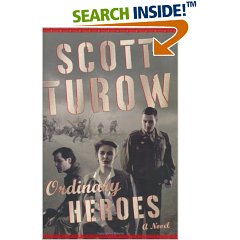
I am reminded of all this because I’ve just finished listening to the latest Turow work, Ordinary Heroes, in audio format. The book is a bit of a departure from Turow’s other fiction works in that the main story takes place during World War Two, following Captain David Dubin of the JAG core (Judge Advocate General). Of course, the book still touches on Turow’s ever present fictional Kindel county, by framing the Captain Dubin story with one of his son, a reporter in modern day Kindel.

So between that first book on tape 15-16 years ago and this latest one a lot has changed. Subject to a whole lot of “car time” over the years, I’ve only listened to probably around 200 more books in what would otherwise be “junk” time (okay, I don’t know exactly how many, but it must be in that range). Of course for the past several years it’s been much better. Instead of tapes, you load multiple audio format books onto your iPod. Instead of abridged version, you get the entire book. And thanks to companies like Audible.com, you have access to a much wider assortment of “reading” material.

Yes, I still “read” the real way, but the advantage of these books on tape is that you can absorb that much more. I tend to devote most of my “real” reading to things that I consider work or career related (okay, sometimes loosely). The books I take in on the iPod tend to be the “fun” stuff I might not normally make time to read. Or it may be all those books I wish I had time to read, but can’t seem to find the time.

Sunday, January 08, 2006

American Capitalist


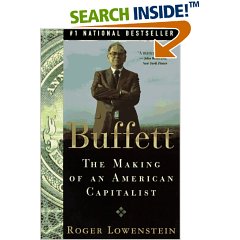
After a false start of just a few chapters last year, I’ve recently picked up and finished pouring through Roger Lowenstein’s biography of Warren Buffett, “Buffett – The Making of An American Capitalist.”

This book is a great read, especially for any like-minded business-book junkies like me. Having said that, I’m not sure there is a whole lot I can say about Warren Buffett that a thousand others haven’t beat me to many times over. However, what does occur to me is that I can further clarify a post to this blog I made back in December.

In a post prompted by the "news of the day," and entitled “Predators serve a purpose, (Dec. 11th)” I talked a little bit about my view of corporate raiders serve a purpose by keeping the management public corporations on their toes. Since Warren Buffett has often played the White Knight role, protecting the occasional good management team of a company put in play by raiders, it occurred to me that I should also highlight what I think is a much more important, perhaps even “noble,” component of the free market – the true long term investor.

From the book:

“One time, Buffett said an investor should approach the stock market as if he had a lifetime punch card. Every time he bought a stock he punched a hole. When the card had twenty holes he was done—no more investing for life. Obviously, the investor would filter out every idea but the best.”

Much more than corporate raiders, the long term investor holds up and supports our market system by financing industry. Warren Buffett actually stands out among the world’s super-rich because his fortune was not built solely one main business, but instead on his ability to evaluate many different businesses. The brilliance of Buffett is not just that he is able to assess intrinsic value of a business, but also in his ability to allocate capital by repurposing free cash flow from one business into another.

“ What counted was the profit as a percentage of the capital invested. That was the yardstick by which Buffett would grade Chance’s [the top manager at Berkshire Hathaway’s textile mills] performance.” A Buffett would say, “I’d rather have a $10 million business making 15 percent than a $100 million business making 5 percent,” Buffett said. “I have other places I can put the money.”

Incidentally, my favorite business book ever, that is, the one I think if studied enough could probably replace my entire MBA, was written by Warren Buffett himself! The Essays of Warren Buffett: Lessons for Corporate America,” is actually and edited compilation of Buffett’s writings, primarily from Berkshire Hathaway annual reports.

In combination, the two books are a great course on Warrant Buffett the man, and the philosophies that have made him the second richest man in the world.

Thursday, January 05, 2006

Pictures...


I get no credit for this from my friends, but I'm actually a really nostalgic person. Very much from my own personal experience, but I also attach a lot of feeling to famous people I don't know. I came across this picture of Peter Jennings in a "famous people who passed away in 2005" article. It's great.

I'm a "big bad Republican" who loves to rail at media-bias I see on the TV (and it's there every day) and I actually think of Peter Jennings, as part of that media establishment. But, at the same time, I totally love Peter Jennings. Somewhere around the age of ten, I really got "into the news." I credit my father, who always wanted to watch the national news. Somewhere a year or two after that I became one of the one or two kids in class who knew the name of foreign leaders - who knew the location of countries around the world.

I forget exactly what year, but somewhere in my life, Peter Jennings and ABC News became my favorite Network news outlet. I know it was my favorite, because my dad would watch one national news show at 6:30, and then we'd switch channels and watch a second on a different network. Later on in life I became a Tom Brokaw fan, but for a good ten years, Peter was the man. I'm very sorry that he's gone....

"Don't mess with Texas!"


I _love_ this picture. All my "commie" friends...eat your heart out! (Totally cop-ed it from Time "pictures of the year," but no one reads my site anyway...

Tuesday, January 03, 2006

Real (good) Sports


I have just seen what I think might be the best hour of sports reporting I think I’ve ever seen. I’ve liked Real Sports, with Bryant Gumble in the past, but I’ve never made it a must see television show. Tonight I watched the 2005 “recap/best-of” show and each story was more interesting than the next. Four stories from 2005 that were heart- wrenching/inspiring, astounding (in a bad way), outlandishly funny (and again, astounding), and finally just plane happy.

The first story was from right here in Boston and profiled Rick and Dick Hoyt. I’m not a native New Englander, but I feel as though every year I have been here I’ve seen some mention of the guy who pushes his wheel-chair bound son through the Boston marathon. Rick Hoyt was choked by his own umbilical chord before birth and was born without the ability to move any part of his body save his head. He wasn’t able to communicate with his own mother and father until hooked to a computer when he was twelve, his first words being “Go Bruins.” In 1977 Rick inspired his father to push him through a five mile road race to inspire a man who had recently become a quadriplegic; this despite the fact that his father was no athlete. Now 65 years old, Dick Hoyt has pushed his son through endless marathons and triathlons—either pushing his son in a wheelchair, riding him on a specially handlebarred bike, or pulling him in a raft while swimming. Even so he beats out many athletes despite the added weight.

The second story was maddening, astounding even in 2005. The story profiles the constant presence of outright, unabashed racism of European soccer crowds. Any time a black athlete in one of these games is passed the ball they are berated with a “monkey chant” or bombarded with actual bananas. Not just a few, but ten or fifteen at a time. That’s a lot of people practicing pre-meditated hate. What’s more, this isn’t just one stadium or country practicing this, but multiple throughout the UEFA. Hundreds of fans at once giving a Nazi Seig Heil salute (Spain and Italy, as well as Eastern European states were singled out as the worst, though British white supremacists were also profiled). I’m reminded of the article I wrote about where France disallows Muslim head-dresses ("What did you expect France?"). I know the United States has a racism problem. I know it’s still there, but this…was…astounding. Horrifying even. No excuse really. I’m certainly going to pause the next time one of my liberal friends tells me that we need to worry because “W” has lowered the respect of Europeans around the world. (yes, I know it’s an unfair generalization- but they obviously have their own issues).

The third story was finally funny – in a “this is unbelievable?” kind of way. In Kentucky there is a horse by the name of Storm Cat. A grandson of the famous Secretariat, Storm Cat only made around $500,000 total in winnings as a racer. However, it turns out that the offspring of Storm Cat had a gift for running ($90 million total in winnings so far). As such, Storm Cat gets sold out for stud. Twice a day, seven days a week, 365 days a year Storm Cat…has sex with other mares (that’s 730 a year “for those of you in Rio Linda” minus a few repeats and rejects). The Stud fees for Storm Cat are…hold on to your hats here…$500,000 for each conceived horse. Given that the horses are timed to be in heat, that’s a lot of baby horses, $20 million per year at the current rate. Storm Cat is currently the father of at least 1,200 horses! Probably the funniest, and at the same time unbelievable thing I’ve seen on TV in a long time.

Lastly is the story of Ryan Belflower, a special education student who beat the odds by making the varsity basketball team at his High School. The story is heart-warming, and good, and reminds me of the movie Rudy. In the end Ryan gets to play in “junk time” during games where the team is either winning real well or losing real bad. The story ends happily when Ryan finally makes a shot in his 26th game, and last chance in regular season as a senior. He goes on in a playoff to make two straight three pointers. The best part is the overwhelming support of his community and school, proving that sometimes, people…are just…good.

Great show. (HBO is _SO_ much better than normal TV).

Monday, January 02, 2006

Rich is right

Rich Karlgarrd's latest column is must read. It's entitled "The World's Worst Disease," and unforuntately too man people have it....

“It won’t fail because of me.”


I just finished reading Andrew Chaikin’s book about the Apollo program entitled “A Man on the Moon.” This is a fantastic read, especially for someone my age who “missed out” for the most part on the most exciting piece of America’s space program. Having been born in 1970, I of course missed the first landing on the moon in 1969, and was blissfully ignorant of the five other landings that finished up in 1972. At this age, men having walked on the moon –the moon – has always just been a fact of life. I feel cheated for not having been born at an age where such a fantastic voyage was still just a possibility.

This is a great book for reliving the excitement and wonder of what is surely the greatest exploration missions undertaken by man. The book is a fantastic narrative of who the Apollo astronauts were, how they made it to the moon, and what they did there. But putting the amazing adventure and science aside, what the Apollo program really is is an example of an enormous undertaking done right:

“It was being part of a team that was dedicated to something that transcended individual aspirations. That’s what Apollo was. It was thousands of people who were willing to work day and night…You can’t imagine what that’s like compared to an every day experience. “
- Ken Mattingly, Apollo 16

“The Lesson,” as Chaikin explains of Apollo, “is that we can do difficult things, when the objective is clearly defined, and when enough people and funds are dedicated to accomplishing it.” I am struck by what a huge, wonderful, and unquestionably good thing this was, accomplished on the backs of literally thousands and thousands of people who all said to themselves, “it won’t fail because of me.”

Of course, reading this book every page you’re continually struck with the thought, “why did we stop?” Men have not walked on the moon now for thirty-four years. As one of the astronauts points out in the book, the moon has a surface area one quarter that of the Earth’s. Why should we think we have it figured out because we visited it in six small places? If mankind is to explore space further, it inevitably will re-start with the moon. There is no Mars landing without first revisiting the moon and “setting up shop.”

The real tragedy of the Apollo program is how we just abandoned it and all the knowledge gained with it. You might think that since we did it once that we could, with a little elbow grease and a few greenbacks, accomplish it again. You’d be sadly mistaken. In truth, everyone who made Apollo is gone. The scientists, the engineers are all retired or dead or both. You may think there’s massive blueprints that NASA can just pull out of a drawer and rekindle moon missions when it pleases, but unfortunately it doesn’t work that way. As Ken Mattingly warns, “If you don’t build things, you don’t know how to build things. We can’t handle a ten-year hiatus. There won’t be anybody left.”

It’s both incredibly exciting and at the same time sad that the real action in space at the beginning of 2006 is in private space flight. Burt Rutan and SpaceshipOne have jump-started a private space industry that will eventually be mammoth. Unfortunately the achievement has nothing to do with exploration, but more of applied engineering. Just like any “cheap revolution,” as Rich Karlgarrd calls it, the reduction in price of anything really good will foster it’s increase use. Space tourism will come to the masses eventually because so many “rich” people are willing to finance an as yet un-built private space ship fleet by committing $200,000 of their own money today.

While any space enthusiast has to be excited by the coming onset of a private space industry and its associated price deterioration, there still remains a role for a publicly financed space program. In a word, “exploration.” Thomas Jefferson opened up a whole new world for the United States when he financed Lewis and Clarke’s expedition through the West. You could say that over time adventurers would have found the same routes, but exploration and scientific discovery is sometimes better when done in the name of a people. I think the world would be well served by another Jefferson or Kennedy pushing us to explore further.

What I really wish is that I’d been old enough during the Apollo program to have had that “holy-s***, they did it!” feeling. Now that it’s so far in the past I worry that not enough of us sit around thinking what it’s like on the moon, or even what's next.

“It’s the moon that people want to hear about, and like all his colleagues, when [Pete] Conrad is introduced as one of the twenty-four men who went there, the question he is almost always asked is, What was it like? And he gives the neat, two second answer he developed long ago: “Super! Really enjoyed it!”

Friday, December 30, 2005

Sobering


The Boston Globe today has published on their website pictures and brief bios of all of Boston's 2005 victims of homicide. Seventy-five people in all (so far - two days to go). It's a ten year high for murders in Boston. Looking at the pictures on this page you'll find that murder victims in Boston are mostly young black men. Just eye-balling it from the pictures I would say close to 90%. Reading through the page you'll find that the most prevalent way to be killed is to be shot, with stabbings a distant second.

I'm a conservative and put a great deal of faith in the U.S. Constitution. As such, I really do believe in the Second Amednment right of citizens to legally own and bear arms. At the same time, looking at a page full of people murdered with guns can't help but give any reasonable person serious cause. If we were a country with out prevalent, easy access to firearms would most of these people be alive? Logic tells me the answer is "absolutely!" Sure, some of those people may have been killed otherwise with a knife or other method, but more likely handguns are just far too easy a way to kill people.

Even still, I do not believe gun control laws will put this genie back in the bottle. It is an assumption on my part, but I don't think I'm that crazy to guess that most of the guns used in these crimes were handguns, and that most of them were illegally obtained. I do subscribe to the theory that if you make guns illegal (or just harder) to own, only the criminals will have the guns. Perhaps that's an oversimplification, but I do believe it's the case.

Looking at a map of where most of the killings took place, combined with the listed occupation for most of the murder victims, it's probably fair to state that most of these killings happened to lower income individuals. Given that the there is a clear dominant trend of a single demographic being victims, there must be a single overall cause, either environmental or cultural or something for this. I absolutely don't believe in a direct correlation between being poor and proneness to violence. Obviously, if that were the case you'd see a larger distribution of other races and more women who are also poor committing these crimes.

There must be an answer. Given that no one can wave a magic wand and make gun disappear, what is it? More police? More after-school programs? More role models? More welfare? More job training? More opportunity? More scholarships? More busing? Is there even a government solution to this problem? It would appear that somehow young African American men need to be reached en mass somehow, but what is it?

Thursday, December 22, 2005

A nobel cause


"In Iraq, more than 10.7 million votes were cast by about 69.9 percent of eligible voters, the commission reported. By comparison, 64 percent (or 126 million) of Americans eligible to vote reported casting ballots in 2004, the U.S. Census Bureau says...." (from CNN.com)

Hmmmm....well, those aren't American Idol numbers, but damn if that is not a major foreign policy success for the United States of America. Gee, could it be that the impatient, vision-less, naysayers of the left (and right) were wrong and that all people yearn to be free?
Those with a real vison for the Middle East see the potential for the Domino Theory, only a democratic one.

Monday, December 19, 2005

Dad


I’ve felt very uncertain about whether this post was something I wanted to publish on my blog. I’m worried that it may be far too personal to share and worry it might not be appropriate. It’s about my father. My dad died last week suddenly at the age of 74. I hate so much that he is gone and that perhaps I didn’t fully appreciate everything about him before he was gone.

My father disagreed with me most of the time on politics, but he really did love a good discussion. He was very enthusiastic about this little blog exercise I have going and was very supportive. I’ve found writing to be a very interesting experience these past two months “blogging,” and I think putting words down on (virtual) paper is going to be a core piece of learning to cope with our loss. I certainly don’t think it will stop at this post, but the words I wrote and spoke at his memorial were my best effort at a tribute to my dad. I’m not certain why I’m holding back on whether to share them. I spoke them to a room full of many strangers, and I put them on the blog here in hopes that someone might learn something about the great man that was my father. I post it here because I love him so much.

My talk (you’ll just have to imagine me choking up three or four times….)

Over the past few days I have been reflecting on my father’s life and the experiences that shaped it. What has occurred to me more and more is that while you might not be able to tell at first look he was actually a complex man with many sides to his personality.

One of my favorite sides of my father that I would like to share with you was who we always referred to as “Dr. Ditson.” If you asked him about how hospitals and doctors had affected his life, he probably would tell you story after story of how the times he had been in the hospital with one surgery or another and how incredibly miserable the places were. But I think this piece of my dad that I admired so much was also shaped by hospitals.

If you were ever in the hospital and were confused about the things being done to you by poking and prodding by the medical profession, you could not have any stronger a set of advocates than Bob and Joan Ditson. If there is anything I’ve learned from my parents about medicine over the years it is that just because someone is a doctor, (my dad’s words) it sure as hell doesn’t make him smarter than you. Doctors and nurses are good people that are there to be a resource for you- but as my father would say, you need to “watch them like a hawk.” Your good health is yours and your family’s responsibility.

I’m pretty sure I have never seen my father be more on a mission than when he was taking care of my mother after her stroke. In the fall of 1989 my mother had a pretty severe stroke. She has been a strong woman my entire life but I am positive she could not have pushed through and gotten to where she is today with out the absolute singular focus of my father. Outside activities were dropped, friends were appreciated, but secondary, and the sole focus of his life became my mother’s welfare.

Everyone loved the image of my father with his shorts, chamois cloth shirt, his wool hat, and wool socks, and his collection of utility belt items clipped to his hip. But when something important needed to be done or a doctor needed to be pulled into line, my dad would assume his Dr. Ditson persona – dark blue suit, his red “power” tie, and his ever-present clipboard full of questions.

My father spent three years in the hospital in the early 1950s, mostly alone, with no similar advocate of his own. His mother lived far away, and could not visit often because of money. There is no question that those difficult years shaped the rest of his life. With my mother in the hospital, this time was different. She had a champion. With my dad on the job, doctors returned calls, they answered questions, and she received the right medications and treatments on time.

If there was anything that my father’s hospital experience built in him it was a deep and profound understanding of pain and hurt. Because of that my father built the gift of compassion and of empathy. Over the 13 plus years my parents ran the motel there is story after story after story after story….of complete strangers sitting in that motel office with my father and my mother—pouring their hearts out about their struggles and their pain for hours at a time. People just don’t do that with strangers unless they detect real compassion and caring in a person. And my father had that.

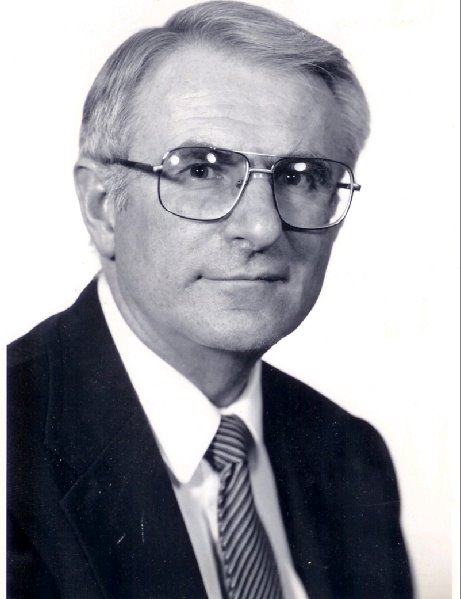
My dad was really supposed to die in back in the 1950s. He had Ulcerative Colitis, which lead to three major surgeries which were at the time still not considered to be routine. When he was leaving the hospital the doctor basically told him that the results of the disease meant he should limit his hopes for life, he said that his highest aspiration might be as a hospital orderly. The doctor told him this. If that probably well-intentioned, but short-sighted doctor were here today I’d ask him to take a look at the pictures of my dad we have here today. They’re pictures of a successful 30-year professional, a second-career business proprietor, and a loving husband, father, and grandfather.

My mother and my daughter and I are all very thankful that Bob Ditson decided to endure for fifty plus more years. We are very thankful for the time we had with him and want to thank you all for being here as our friends.

Tuesday, December 13, 2005

On Message, finally!!!


I don't know if it's the Brain or if it's Karen Hughs back on the job, but "W" is finally getting on message! President Bush, from the same Brian "Barbie" Williams interview mentioned in the last post:

"My strategy and my plans are these. I will listen to the commanders. I understand that war is objective based, not time table based, and we will complete this mission for the good of the country."

YES! "Objective based." They're reframing the discussion to be about how to WIN, not when we're going to exit. This is positive.

I'm Chris Matthews, and you're not


Ugh, Chris Matthews is such a bore. Tonight on Hardball they keep showing and totally HARPING on the Brian Williams interview on "does the President read?"

So the questions from Williams went like this... (paraphrasing) " Here is Time and Newsweek, do you read these magazines." Answer, "no I really don't." Then "How much of the network news do you watch?"

First of all - Time and Newsweek are pretty much crap! These are MASS market magazines that have some fine articles, but are really just People Magazine level consumption of the news. Sure, they have some good articles, but other times it's "McNews magazine-ed down." The same goes for the Nightly News on any of the networks! It is produced for mass consumption. If you want to be a truly informed person in this country, you MUST read from multiple sources (I'd say three or more a day- probably more). And at least five or six different sources a week- probably more.

Then Matthews asked something totally asinine of Brian Williams, "Did you get the feeling Brian that he really wanted to do this interview or his uh, public relations people said you have to get out there and kill the idea that you're isolated." Then followed a very serious reply by Brian Williams to this silly question. UGH! I like Hardball, I watch it all the time, but oh my God! Chris Matthews is such an arrogant ass! Just come out and say you hate the President! Having these totally random, unimportant, and completely pointless conversations about whether the President felt like having an interview with Brian Williams - a male Barbie doll - is ridiculous. Of course he didn't! Who wants to talk to an overly-biased thick head who is paid to basically try and trip you into saying something dumb?

I am SO SICK of the insuation that the President of the United States is uninformed or stupid. It is way too hard to become the President of the United States of America - one in 300 million people each election (well, less considering the number of elegible candidates) to be a STUPID person and get elected. Just get over it. Stop the silly media machine.

When the President answers Barbie Williams that yes in fact he does read the papers, what Paper do they show in the produced-by-a-liberal-member-of-the-media news story. USA TODAY -- the nation's "McPaper." Give me a break.

Monday, December 12, 2005

Only in America


I love the Arnold Schwarzenegger story. You need go no further than his speech to the Republican National Convention in 2004 to understand why this is a great American story. This is a man who grew up in the shadow of communism and made himself into a world class athlete, a powerful movie star, and finally a voice of the people in the form of the Governor of “Kali-FORN-ya!” What a perfect example to the rest of the world – in America, anything is possible, anyone can make themselves a success. Only in America.

My admiration and love for the story aside, I will admit to just a little bit of a surreal feeling to see Arnold Schwarzenegger deciding the fate of inmates on death row. Today the governor denied clemency for Stanley Tookie Williams. Mr. Williams is one of the founders of the Crips street gang, and the convicted murderer of four people. Mr. Williams cause has been taken up by several Hollywood movie stars, as well as many anti-death penalty advocates.

It would seem that Mr. Williams has worked tirelessly since his incarceration in the late 70s to reform himself. He has written multiple children books warning of the dangers of street gangs. He has even been nominated by a Swiss legislator and some college professors for a Nobel Peace Prize (only in America!)

I am not surprised by Governor Schwarzenegger’s decision to deny clemency. Only in America would a death sentence be drawn out for twenty-four years while the condemned is allowed to exhaust every single avenue in his or her defense. I think that’s a good thing for our system, and actually shows our humanity. At the same time, that’s twenty-four years that the four people Stanley Tookie Williams murdered never will have.

See, I told you so ;-)

"By the way, Governers get elected president I’ve noticed the pattern, Governor Romney. "

-Chris Matthews on Hardball tonight. Interviewing your next President, Mitt Romney.

Sunday, December 11, 2005

Predators serve a purpose


Chances are as an individual investor, you don’t have much say in the management direction of your favorite publicly listed company. Sure, you may be a billionaire, or even an “A” list hedge fund manager, but chances are (given my small readership) your biggest equity investment doesn’t include much in the way of voting rights. I bring this up because of the latest in Wall Street dramas to hit the business press.

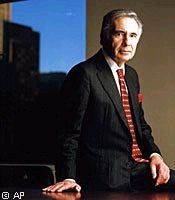
Every so often a story comes up that is worth reading every episode. Eighteen months or so back it was Oracle’s fight to acquire Peoplesoft. Today the most interesting soap opera of the business world is Carl Icahn versus Time Warner. This is a story that promises to play out for a good portion of the New Year. Essentially, Carl Icahn is a corporate raider who is angling for the ouster of Time Warner CEO Richard Parsons, as well as for the break up and sell off its cable assets.

Ever since Barbarians at the Gate, I’ve loved a good buyout story. Partly I enjoy them for the drama, but I also appreciate how some of them are illustrative of how free markets and the “profit motive” benefit the greater good. It’s almost cliché that any time Hollywood wants to portray a businessman as “evil” it reaches for the a fat cat CEO or for the stock “Corporate Raider” persona. Gordon Gecko, as portrayed by Michael Douglass, in the movie Wall Street was a Corporate Raider, as was the “bad” Richard in the movie Pretty Woman. (Don’t get me wrong, as portrayed in the movie, Gordon Gecko was a cheater—not part of a positive free market). I wonder if Hollywood understands that corporate raiders are the bane of the “fat cat” CEO’s existence.

In reality, corporate raiders serve a purpose. Motivated by financial gain for themselves and their investors, corporate raiders cull the herd of the weakest competitors. In doing so, they weed out bad management teams, they add transparency into the finances of public companies, and unlock unrealized market value. It was profiteer short-sellers, among others, that brought the Enron house of cards crashing down. It is buyout artists that find companies that are being abused by their management teams.

Let’s go back to my starting premise. Say you’re an individual investor that is approaching retirement and have held Time Warner stock in your 401k account since 1995. Basically, you got screwed. Time Warner made what is widely called, the worst business deal ever, by overpaying for America Online. Your stock lost a considerable amount of its inherent value in this transaction. If you stuck in there and are still holding the stock you may in fact get some of that value back. One way that might happen is that the company may actually deliver on what it says it’s going to do. Another way is to have Carl Icahn or someone like him come along.

Carl Icahn is smarter than you (probably – certainly smarter than me). He’s also a pretty powerful guy, able to control billions of dollars. Mr. Icahn has made his fortune opportunistically. When he finds a company that he believes is not managing its assets properly, he steps in. He does that by taking a position in a companies publicly traded securities (either stocks or bonds). In effect he becomes a large owner or holder of the company’s debt. Then he becomes and “agitator” for change. Rightly or wrongly, he pushes for changes in the company that he believes will increase the value of the company.

In the current situation, Mr. Icahn believes Time Warner investors should have the choice of owning either cable assets or content assets (both currently owned by Time Warner in a single entity). He thinks the parts are worth greater than the whole, and a part owner of the company is pushing to split them up. Furthermore, he thinks management is overpaid. He points out, “At Time Warner they spend $500 million a year for the top layer of executives, and it’s unnecessary.” Maybe that is a reasonable number, but it does sound like a lot, doesn’t it?

I doubt very much that Carl Icahn is thinking much about your little Time Warner position in your 401k. I could be totally wrong. Maybe he is motivated by helping the little guy. The point is, it doesn’t matter. “Corporate Raiders” have just as much influence on keeping the management of public companies honest as does the SEC. This isn’t to say that corporate raiders have a monopoly on the right way to run businesses. Mr. Icahn could be completely wrong. This could be a play for “greenmail,” essentially an agitator financier’s way of getting paid off to go away – not positive for the company or your 401k.

I don’t want to give the impression that I think everything that results from the break up of a poorly run company is positive. Individual lives are often affected. People get laid off sometimes. Pension funds get raided sometimes. (Both of these happen through management teams sometimes as well). Sometimes the buyout artists are overleveraged, or incorrect in their estimates of unrealized value.

My point is not to paint corporate raiders in a good light as wonderful people. The point is that it doesn’t matter. Their self interest acts as one of many driving forces in an overall free market, and some of those affects have a decidedly positive affect. How will the Carl Icahn versus Time Warner drama end? Only time will tell.

Thursday, December 08, 2005

Guilty Pleasure


Since my own personal political “inflection point,” somewhere around 1993, I’ve done my best to expose myself to various forms of conservative thought. From Rush Limbaugh to William F. Buckley, to the Conservative Chronicle, Newt, National Review, Sean Hannity, Jay Severin, Laura Ingraham, Weekly Standard, Dinesh Desouza, George Will, and the ever present wisdom of Ronald Reagan – I’ve covered a whole lot of the landscape. Living in Massachusetts, there have certainly been times (especially early on) when I felt the need to “cover up” my reading material, if only to avoid the occasional shocked look. (Note to self, when your boss ‘tsk tsks” your copy of The Fountainhead, you need a new boss).

Well, I’m way over that now. At work I’ll keep it under wraps, but in ‘real’ life I’m much more likely to overtly champion what I believe is the better way. Of course, even conservatives have their guilty pleasures and for a great deal of us that pleasure is the writing of Ann Coulter.

I’m certainly not afraid to tell people I love her books and her column, but I’m sure I’m not the only conservative that gets just a little bit uneasy admitting that. The reason is that Ann Coulter is the conservative equivalent of a buzz saw. She is just a little bit over the top, just a little bit past the limits of propriety that it at times gives you pause. At the same time she is so smart, and her writing is so….wickedly funny, that you can’t help but reading more. The best way I can describe it is that she has an uncanny knack for eviscerating liberalism’s sacred cows. She pulls no punches, has no fear, and damns the consequences.

Of course, this boldness makes her a lightning rod for left-wingers who try to stop her from speaking at every turn- most recently in Connecticut, as described in an article from the Associated Press. I always think it’s ironic that liberalism, a word that means tolerance for new ideas, has been hijacked by a group that attempts to squash speech that they do not agree with at every turn (look no further than “political correctness.”)

As might be expected, many liberals never take the time to listen to what you say. Once they hear you’re a conservative they just lump you all together as “Bible thumpers” or the “great Satan,” or in a dashing bit of liberal logic, both. But what liberals never bother to realize about Ann Coulter is that she is a bit of a pariah to Conservatives as well. Politicians can’t get near her. Because politics is the way it is, to have your picture taken with her, it would align you with her over-the-top comments across the board. Some of her comments are so brash (even if true) that I can’t really blame them. The people that I can call gutless when it comes to Coulter are the conservative press. Ann Coulter sells copy – she has four best selling books, and millions of readers of her weekly column on Townhall.com. But still, publications like National Review, Weekly Standard, WSJ, Washington Times, etc. all shy away from publishing her column.

The best mainstream exposure in a popular periodical she got from the other side of the aisle – JFK Jr. hired her to write a column in George Magazine years ago. She wrote a great tribute to him in her book “How to talk to a Liberal – if you must;” a great read. Today you can read her columns at Townhall.com or on her web site, Anncoulter.org. Also, there’s a great documentary about her on DVD entitled, “Is it true what they say about Ann?”

Tuesday, December 06, 2005

“Lead” to win or “Manage” to Defeat


A perennial favorite topic of the business press is that of the difference between “leadership” and “management.” Typically both are attributed as absolutely necessary to an organization’s success, but requiring very different sets of talents. I was reminded of this debate by the prevailing democratic talking point of the past few weeks which seems to be “Bush mismanaged the war!”

The “mismanaged” slogan I think highlights a profound difference between the way different groups in this country approach the difficult and grueling task of actually winning a war. History would teach us; it seems to me, that victories are “lead,” while defeats are the result of an attempt to “manage.” Sure it’s a total bastardization of the leadership vs. management debate, and perhaps an over simplified view of warfare, but I think it’s an interesting view of how our various “leaders” approach this issue.

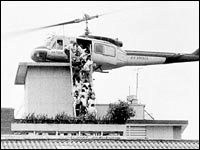
One thing that I continually fault the Bush administration on is allowing the Democrats to set the stage for the debate around the war in Iraq. Instead of a political establishment that is arguing constructively how to win the war and build Iraq, the topic of the most argument is exactly when U.S. forces will leave. Essentially you’ve got the “get out now crowd,” the “give us a timetable to withdraw ‘honorably’” crowd, and then everyone else. People arguing that we should withdraw with “honor,” are basically arguing that we can’t win and that we should find a way to get out without the bad news footage equivalent of the last helicopter leaving Saigon in 1973. The only honorable course is to do what we say we’re going to do no matter how long it takes.

The loudest opposition voices out there today are the voices of defeat. Democratic national Chairman Howard Dean was quoted yesterday as saying, “(the) idea that we're going to win the war in Iraq is an idea which is just plain wrong.” What he’s really saying is that he doesn’t believe in the United States ability (or will) to win. Of course, that didn’t stop him from going on to say,

“I think we need a strategic redeployment over a period of two years. Bring the 80,000 National Guard and Reserve troops home immediately. They don't belong in a conflict like this anyway. We ought to have a redeployment to Afghanistan of 20,000 troops, we don't have enough troops to do the job there and its a place where we are welcome. And we need a force in the Middle East, not in Iraq but in a friendly neighboring country to fight (terrorist leader Musab) Zarqawi, who came to Iraq after this invasion. We've got to get the target off the backs of American troops.”

Wow, when I think of someone who will “mange” the war correctly, I think of a M.D. from Vermont! Not. Sarcasm aside, serious Democrats’ stomachs must turn somersaults when they hear their bomb-throwing Chairman speak. Every other thing out of his mouth is a “Bush lied” conspiracy.

When you think of unsuccessful U.S. military conflicts like Vietnam or Korea (okay, that was a tie), what do you think of? Many people think of major interference (i.e. “management”) from Washington D.C. Truman fired McArthur for trying to win the Korean war. Most criticism of Robert McNamara was that he micromanaged the fighting of the Vietnam war. Nixon had his fingers all over the bombing of North Vietnam and Cambodia as if he were a field commander.

In contrast, successful undertakings by the United States in the last century were the result of great acts of leadership. FDR and Winston Churchill led us to victory in World War II. Ronald Reagan led us to victory in the cold war. (I’m leaving out WWI, yes it was a big deal, but direct U.S. involvement was much shorter than even our current stint in Iraq). In each of these victories, these leaders made their primary role one leadership. The first job of “leadership” is to set the vision of a successful outcome. FDR, Churchill and Reagan all called out the enemy for what they were, they defined success, and they harped on it over and over again. They all took part in the management piece of these efforts, but each delegated the real “management” of war efforts to their military leaders. Very “Lincolnesqe.”

I’m left to wonder what an appropriate battle cry might be for “mismanaged war” crowd. Perhaps, “Remember _We Lost_ at the Alamo!” The fact that as a country we’re spending so much time arguing about when to get out is completely the wrong focus. The United States is the single super power in the world. It _should_ go without saying that we have the will to complete efforts we take on. The Bush Administration should continually reframe the debate around “what’s the best way to win?”

Monday, December 05, 2005

She's no Bill


I’m continually baffled as to why Hillary Clinton is referred to as the far-and-away frontrunner for the Democratic Presidential nomination in 2008. Yes, I understand her celebrity and, sure I appreciate the novelty of having a candidate who used to be the first lady. But really…are Democrats really thinking through what they’re getting when they anoint her as their favorite-son (daughter)?

It wouldn’t be the first time a candidate road the coattails of a popular President to win their party’s nomination (you listening Bush 41?), but I wonder if the “Clinton” mystique is getting ready to hit a brick wall. By all accounts Bill Clinton has an uncanny ability to connect with virtually anyone he meets. It is said that in a conversation with President Clinton he makes you feel as if the whole world is about you. Honestly, pudgy, middle-aged white guys do not get the title “America’s first black President,” without "mad" interpersonal skills.

Other than the celebrity, I just don’t see what it is about Hillary Clinton’s candidacy that makes Democrats swoon. Okay, yes, I’m biased. Based on her stated beliefs I think her policies would be a total disaster for the United States. But trying to be objective, and looking at just the basics, just exactly what kind of candidate do they have.

She’s Polarizing – Hillary Clinton is possibly one of the most polarizing political figures in America today. Hillary is to conservatives what “W” is to Moveon.org. You either love her or you hate her. Bill Clinton was able to bring out the moderate votes, in fact, he based much of his first campaign on being a pro-business moderate Democrat. Heck, I voted for him (the first time).

She’s a New York Liberal - She may hail from Arkansas, but she wasted no time in knocking the dust off those boots as soon as Bill was out of office. To get elected as a Democrat way back to LBJ you needed some Southern “street cred,” and she forfeited that when she moved to New York state to run for Senate. People with that liberal tag don’t do well in the presidential election. Sure, she’d win New York state in a landslide (provided Rudy doesn’t run), California, and of course Minnesota, among others, but everywhere else she is a “New Yawk Liberal,” with all the connotations that come with it.

She’s a Senator - I always bring this one up. We don’t hire too many Senators in this country to be the Commander-in-Chief. The last President who was a Senator was Lyndon B. Johnson, but of course the last one we actually elected was John F. Kennedy. I think John Kerry was the perfect example of why we reject congressman as Presidential candidates. Who ever knew what the guy was talking about? The Senate is an old boys club that is run by obscure rules of order known mostly to themselves. If you don’t believe me, read the great book on LBJ called Master of the Senate. Senators “do” less and “argue in circles” more. We’re Americans and we want a “doer!”

She’s a woman – In my opinion the United States absolutely IS ready for a female commander in chief. I’m not just being egalitarian by saying so either. And certainly no one thinks of Hillary as a soft, “Holly Hobby” homemaker type. However, I do question whether her “toughness” will play in Peoria. I can see soccer moms coming out to vote for her (despite the “I could have stayed home and baked cookies” comment), but I do have a hard time seeing “NASCAR dads” coming out to vote for her. Despite her recent attempts to look tough and be strong supporter of the Military , I think she’ll have a perception of softness hurdle to get over – which I honestly think would unfairly be put against any woman candidate. I do think of Hillary as tough (if misguided), and I do think she would apply military force as commander in chief. I just always think of our first woman president as more an Iron Lady type.

She’s not Bill – As I mentioned up above, Hillary doesn’t have the magic touch the way Bill does. They call him “The Natural” after all. I’m not suggesting that you have to be overly gifted in this way to get elected, but I wonder if there’s some transference going on here where all her admirers think they’re going to get the Bill Clinton touch.

She stands for what?– To be a leader you have to stand for something. For the life of me I don’t know what Hillary stands for yet. I’m certain she’ll put something together as part of a formal campaign, but so far all I get is…“because she’s Hillary!” That might work to her advantage in far-left circles, but last time I checked you had to appeal to the middle to win the Electoral College. I’m just looking forward to hear what she stands for. Is it the same as Bill Clinton or does she have her own philosophy, and if so, how are they different?

Doesn’t anyone else just want “new blood” in the White House? I’ve said the same thing about the Bushes as the Clintons – In a country of 300 million citizens; can we really not find a few candidates who are NOT a direct relation of a former President? I’m sure some will argue (again) that it’s a two-for-one deal – elect Hillary and get Bill to boot! You know what, I’ll pass.

My personal bet this early in the nomination race is Joe Biden . The guy never fails to drive me nuts when he’s on the talking head shows, but he’s smart, he’s tough, and I think he’d make a formidable opponent to the open Republican field (and yes, I know he's a Senator). John Kerry will run again, but to steal a Dennis Miller line, he’s going to get “stomped like a Narc at a biker rally!”

Sunday, December 04, 2005

'Cut and run' would be the wrong answer


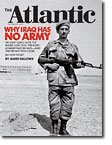
I was asked to respond to an article in The Atlantic magazine entitled “Why Iraq has No Army,” by James Fallows. (FYI- I’m linking to it, but the link may only be good to non-subscribers for a few days). Incidentally, this article was also sited on Meet the Press this morning when Tim Russert asked for a response to the article from Senator John McCain.

I love Tim Russert, but he seems to harp incessantly on mistakes made in the execution of the war. Certainly one of the primary purposes of the fourth estate is to do juts that, but he seems to revisit it over and over with every guest. This morning he asked Senator McCain (I’m paraphrasing), “One of the misjudgments made was that we would be greeted as liberators. Then the cost of the war, --- and then required troop levels – three fundamental misjudgments by the administration, is that fair? ”

McCain’s answer was that it was fair. Sometimes I feel like the there’s this opinion out there that says to the administration “you should have planned for everything. You should have anticipated everything that might have happened and planned for it.” Never mind that we were confronting what we believed to be a clear and present danger that needed to be addressed immediately. Has there ever been a war plan that worked out exactly as planned…ever? Where are these “perfect world” standards coming from that a war is the equivalent of a math proof that can just be worked out with enough elbow grease?

Earlier in the interview Russert asked Senator McCain for a reaction to the following quote from the Article in the Atlantic:

“In short, if American troops disappeared tomorrow, Iraq would have essentially no independent security force. Half its policemen would be considered worthless, and the other half would depend on external help for organization, direction, support. Two thirds of the army would be in the same dependent position, and even the better-prepared one third would suffer significant limitations without foreign help."

“The moment when Iraqis can lift much of the burden from American troops is not yet in sight. --- Measured against what it would take to leave Iraqis fully in charge of their own security, the United States and the Iraqi government are losing ground. Absent a dramatic change—in the insurgency, in American efforts, in resolving political differences in Iraq—America's options will grow worse, not better, as time goes on.”

I think this was a good summary quote from what James Fallows advocates in this long twenty page article, but I’m not sure it tells all of Fallows' story. Senator McCain, probably hearing the quote for the first time, felt obligated to take it as an estimation that there was little or no progress happening, and to respectfully disagree with Fallows.

I found Fallows article to be a well told list of the mistakes made and the many the challenges to succeeding in Iraq, but also a description of the beginnings of progress in training Iraqi security forces. Clearly there have been plenty of mistakes and clearly there are many things the U.S. can improve and recommit to in order to ensure success.

At the same time, I think Fallows touches on what’s really important when he quotes General Petraeus on the importance of training Iraqi forces:

“The enemy recognizes that if Iraqi security forces ever really get traction, they are in trouble. So all of this (training) is done in the most challenging environment imaginable."

And later Fallows makes a conclusion similar to what I said the other day (that we’re not leaving anytime soon):

“Based on these interviews, I have come to this sobering conclusion: the United States can best train Iraqis, and therefore best help itself leave Iraq, only by making certain very long-term commitments to stay.”

In the end it is difficult to know who to believe on the current progress of training for Iraqi defense forces. I was listening to Rush this past week and he replayed Mary Matalin dressing down John Kerry on the Today show about this very topic. Her pronouncements of Iraqi security force readiness make it sound like massive progress is being made—and certainly echoed the end of the Fallows article (in spots). With nothing but partisan assessments one way or the other as inputs, how is average Joe citizen supposed to form an opinion?

For me it comes down to which side is doing a better job at confronting reality. We can’t just leave. We have to stay. In this morning’s interview Tim Russert asked Senator McCain if the situation is the same in six months as it is today, would he advocate a timeline for our pullout from Iraq. McCain responded with the following (good thing Tivo let’s me rewind!)

“I would say that we would have to evaluate our strategy, but We would also have to consider the consequences of failure. If we fail….don’t take my word for it, take Zarqowi’s-- Zarqawi and Bin Laden’s version of history is, we were driven out of Vietnam, we were driven out of Lebanon, we were driven out of Somalia , and they’re going to go after us and the United States of America, ---now that’s not my saying, that’s what they’re saying, this is why so much is at stake here. This is why I made the controversial statement that this is more important than Vietnam. The Vietnamese weren’t going to come after us, these people are dedicated to our extinction.”

I think that McCain’s response was the right one. It is imperative that we stand our ground and build a democratic Iraq. The insurgents know what is at stake, and are showing that in the way they’re fighting. I think those, like McCain, which are proponents of making Iraq a real victory, and not prematurely pulling out of that country, also understand what is really at stake.